
A smaller, more maintainable GitHub Action for auditing Rust dependencies
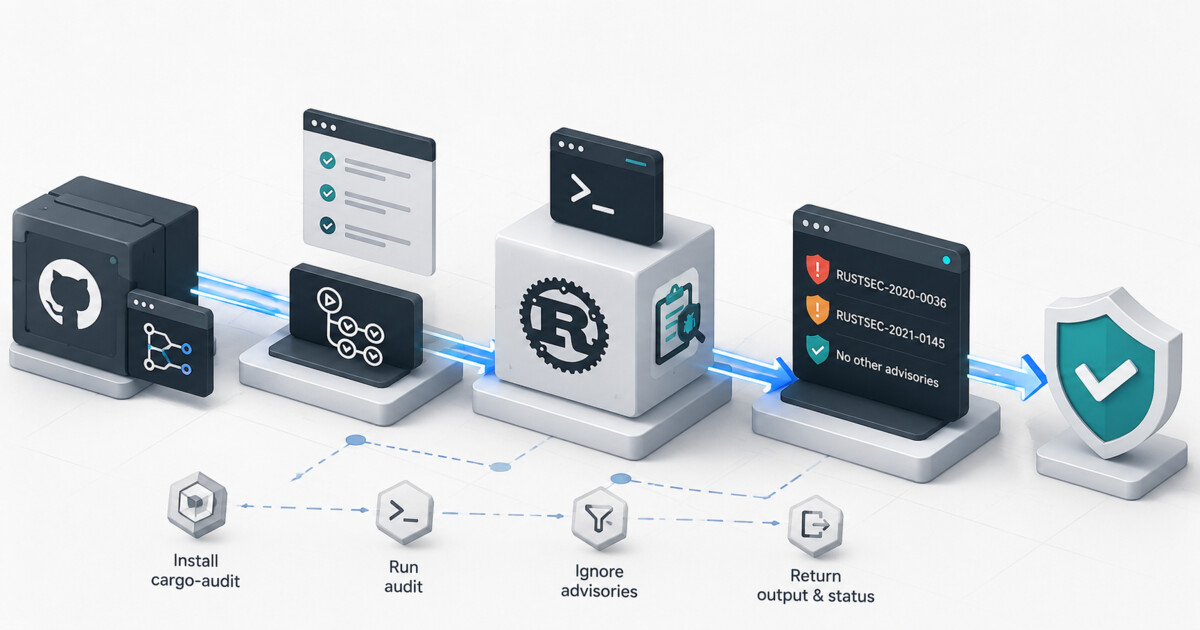
I have just published Rust Audit Check Action, a small GitHub Action for running cargo audit and detecting RustSec advisories in Rust projects. The action is now available on the GitHub Marketplace.
The basic workflow is intentionally straightforward:
- uses: pirafrank/audit-check-action@v1
It installs cargo-audit, runs it against the project’s dependency lockfile, and lets the command output and exit status determine whether the workflow succeeds or fails.
That simplicity is the main feature.
Why create another Rust audit action?
There are already established projects for integrating cargo audit into GitHub Actions, particularly rustsec/audit-check and actions-rust-lang/audit.
However, GitHub Actions do not exist in a static environment. Actions that depend on a specific JavaScript runtime, Docker image, GitHub API integration, or additional reporting layer inherit the maintenance requirements of those components.
A recent example is the deprecation of Node.js 20 in GitHub Actions. Node.js 20 reached end of life in April 2026, and GitHub Actions have already moved to Node.js 24. This is not an unusual or unexpected change, but it means maintainers of JavaScript-based actions must periodically update their runtime declaration, dependencies, generated bundles, and test environments.
Users may otherwise start seeing deprecation warnings in workflows even when the underlying tool they wanted to run—such as cargo audit—continues to work correctly.
Plain. Boring.
So I looked for an alternative that was less exposed to that kind of maintenance cycle and ended up creating one.
Focused on the core audit workflow
Rust Audit Check Action deliberately avoids several features:
- no Node.js runtime
- no Docker container
- no GitHub Checks API integration
- no automatic issue creation
- no additional reporting abstraction.
The action performs the minimum useful workflow:
- install
cargo-audit; - run it in the requested directory;
- optionally pass advisory IDs to ignore;
- return the original command output and exit status.
This makes the implementation easier to inspect and reduces the number of components that can become deprecated independently of Rust or cargo-audit.
It also avoids trying to replace the configuration mechanisms already provided by the underlying tool. For more advanced configuration, projects can commit an audit.toml file and use the standard options supported by cargo audit. The audit.toml file is read automatically by cargo audit, so no additional action input is required.
Example workflow
Here’s a complete workflow example. It runs audits when dependency files change, on pull requests, on a schedule, and even manually:
name: Security audit

on:
  push:
    paths:
      - "**/Cargo.toml"
      - "**/Cargo.lock"
      - "**/audit.toml"
  pull_request:
    paths:
      - "**/Cargo.toml"
      - "**/Cargo.lock"
      - "**/audit.toml"
  schedule:
    - cron: "0 0 * * *"
  workflow_dispatch:

jobs:
  audit:
    runs-on: ubuntu-latest

    steps:
      - uses: actions/checkout@v7

      - uses: actions-rust-lang/setup-rust-toolchain@v1
        with:
          toolchain: stable
          rustflags: ""

      - uses: pirafrank/audit-check-action@v1
Specific advisories can also be ignored when necessary:
- uses: pirafrank/audit-check-action@v1
  with:
    ignore: RUSTSEC-2020-0036,RUSTSEC-2021-0145
The action also supports a working-directory input for monorepos and repositories containing multiple Rust projects.
A deliberately small open-source component
Not every action needs to become a complete security reporting platform.
Sometimes a GitHub Action only needs to connect an existing command-line tool to a workflow while preserving the tool’s normal behaviour.
That is the approach behind Rust Audit Check Action: keep the integration small, predictable and maintainable, while leaving vulnerability detection and configuration to cargo-audit and the RustSec advisory database.
The project is open source under the MIT licence. Try it today on the GitHub Marketplace. Feedback, issues and contributions are welcome.
Thanks for reading.